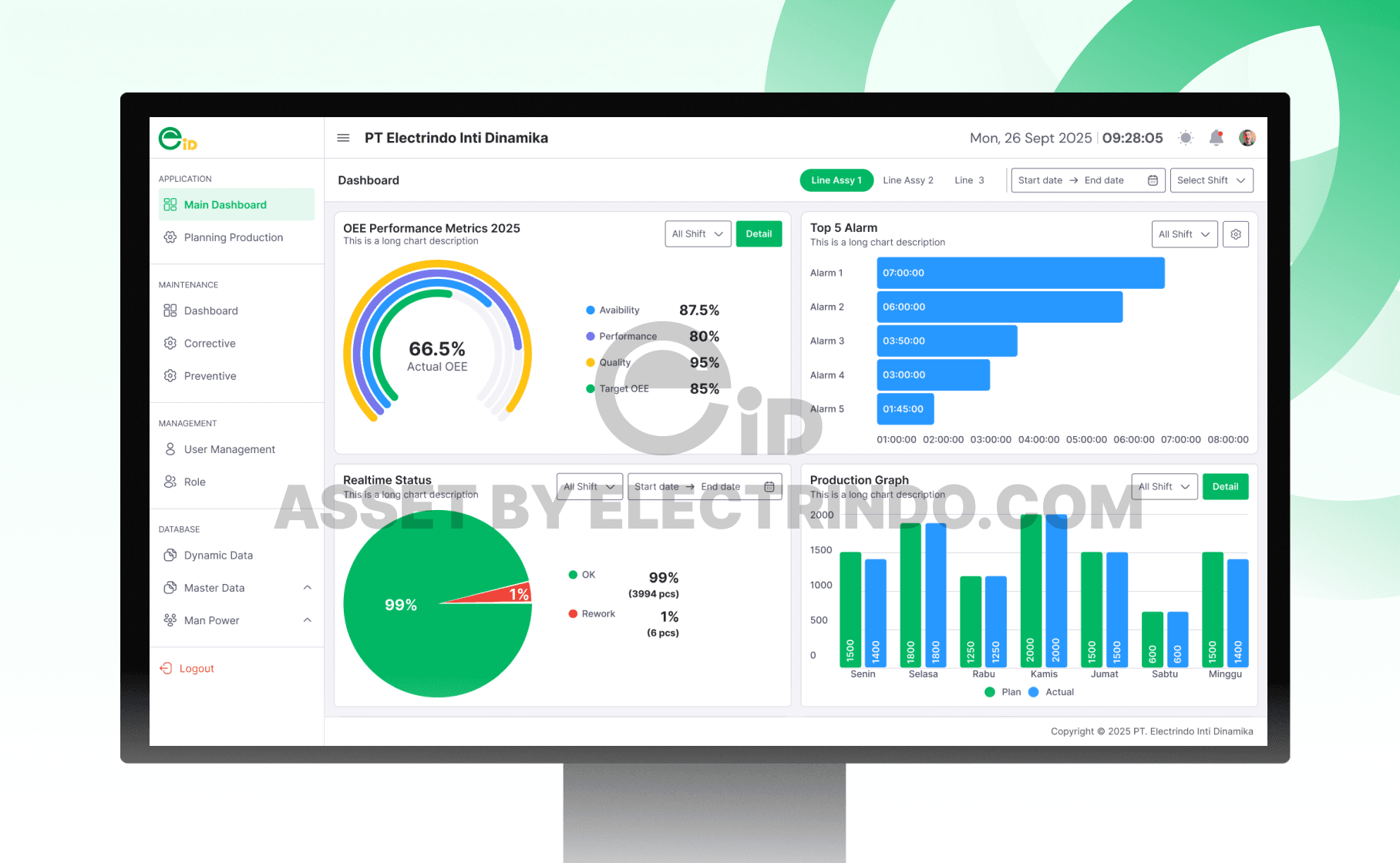
Background
The Line Production Monitoring System is a platform integrated with an IoT Gateway to monitor production line activities and production performance in real time across every production line and shift. This system was developed to provide accurate, centralized, and easily accessible production information, enabling companies to monitor production efficiency, identify downtime or loss time during production, and obtain operational data more effectively.
With this system, production monitoring becomes more structured and measurable, allowing the generated data to serve as a basis for performance evaluation, problem identification, and data-driven decision-making to improve production efficiency and productivity.
The system utilizes data collected from machine PLCs (Programmable Logic Controllers), which is processed into meaningful information for analysis by company staff. In addition, downtime recording is performed through two mechanisms: automatic machine alarm/error collection and manual input via the system. This ensures that every downtime event and its root cause are documented accurately and systematically.
The system also includes a Real-Time Overall Equipment Effectiveness (OEE) Performance feature, enabling production, engineering, and management teams to monitor and analyze machine performance in real time. The resulting insights support performance evaluation, problem identification, and informed decision-making based on accurate production data.
Challenge
Manufacturing industries often encounter operational issues that affect production performance and efficiency. The key challenges addressed by this system include:
1. Production Data Processing and OK/NG Identification
Production monitoring is still largely performed manually, making it difficult to obtain accurate, real-time information regarding the quantity and status of OK and NG (Not Good) products. Machine-generated production data also needs to be processed into structured information that can be effectively analyzed by operational staff. This limitation hinders production performance evaluation and delays problem identification.
2. Accurate OEE Performance Calculation and Visualization
The system must process production and downtime data into Overall Equipment Effectiveness (OEE) indicators that accurately reflect machine performance. The primary challenge is ensuring that the Availability, Performance, and Quality metrics used in OEE calculations accurately represent actual production conditions.
3. Manual and Decentralized Production Planning
Production planning requires determining products, production targets, assigned production lines, and daily schedules. When managed manually, this process becomes time-consuming and increases the risk of recording errors, inconsistencies, and mismatches between planned targets and actual production execution.
4. Production Line Problem and Loss Time Identification
Various production issues can result in loss time and reduced operational efficiency. The challenge is to provide sufficient data to identify the root causes of production issues, downtime duration, and their impact on production performance.
Project Goals
1. Provide real-time production monitoring for OK and NG (Not Good) products to ensure transparent and accurate production quality monitoring.
2. Provide an OEE Performance feature that visualizes production efficiency and helps identify production loss time.
3. Provide a centralized Production Planning feature that simplifies daily and shift-based production target planning.
4. Provide a Maintenance feature to monitor machine alarms and errors, enabling production issues to be identified and resolved promptly.
Features Offred
1. Production Monitoring and Data Visualization
- Real-time monitoring of production data across all production lines.
- Visualization of production performance and operational efficiency through intuitive dashboards.
- OEE Performance Charts for monitoring production efficiency and equipment effectiveness.
2. Planning Production
- Structured monitoring of daily and shift-based production plans.
- Creation and management of production schedules based on daily and shift production targets.
- Simplified production target planning for each production line.
3. Corrective and Preventive Maintenance
- Real-time monitoring of machine alarms and errors to quickly detect downtime.
- Recording all production issues and downtime events occurring on each production line.
- Recording corrective maintenance activities, enabling staff to monitor maintenance history and downtime resolution status.
- Scheduling and managing preventive maintenance activities to support routine machine maintenance.
Result
The implementation of this system has delivered several significant improvements, including:
- Production line monitoring has become more effective, as the system displays OK and NG production data in real time, enabling abnormal conditions to be detected more quickly.
- OEE performance monitoring has become more efficient, with production data automatically processed in real time, eliminating the need for manual recording and calculations.
- Production planning has become more structured and efficient, allowing staff to create, manage, and monitor production schedules more effectively.
- Analysis of production issues and performance trends has improved, particularly through shift-based data, enabling recurring problems to be identified more quickly and supporting more effective corrective actions.
- Monitoring hourly and shift-based production target achievement has become more transparent, as all production data is recorded and available in real time.
- Corrective actions have become faster and more responsive, as the system provides real-time information about events occurring on each production line, allowing issues to be monitored and addressed immediately.
- Machine maintenance has become more systematic and proactive through the Preventive Maintenance feature, which helps staff schedule, manage, and monitor routine maintenance activities in a structured manner.
Contact Us Now
Ready to upgrade your production quality to the next level? Consult your needs with our team of experts. We will help you design and implement the best Andon system that suits your production needs.
📞 Contact Us Now to get the right solution for your factory!