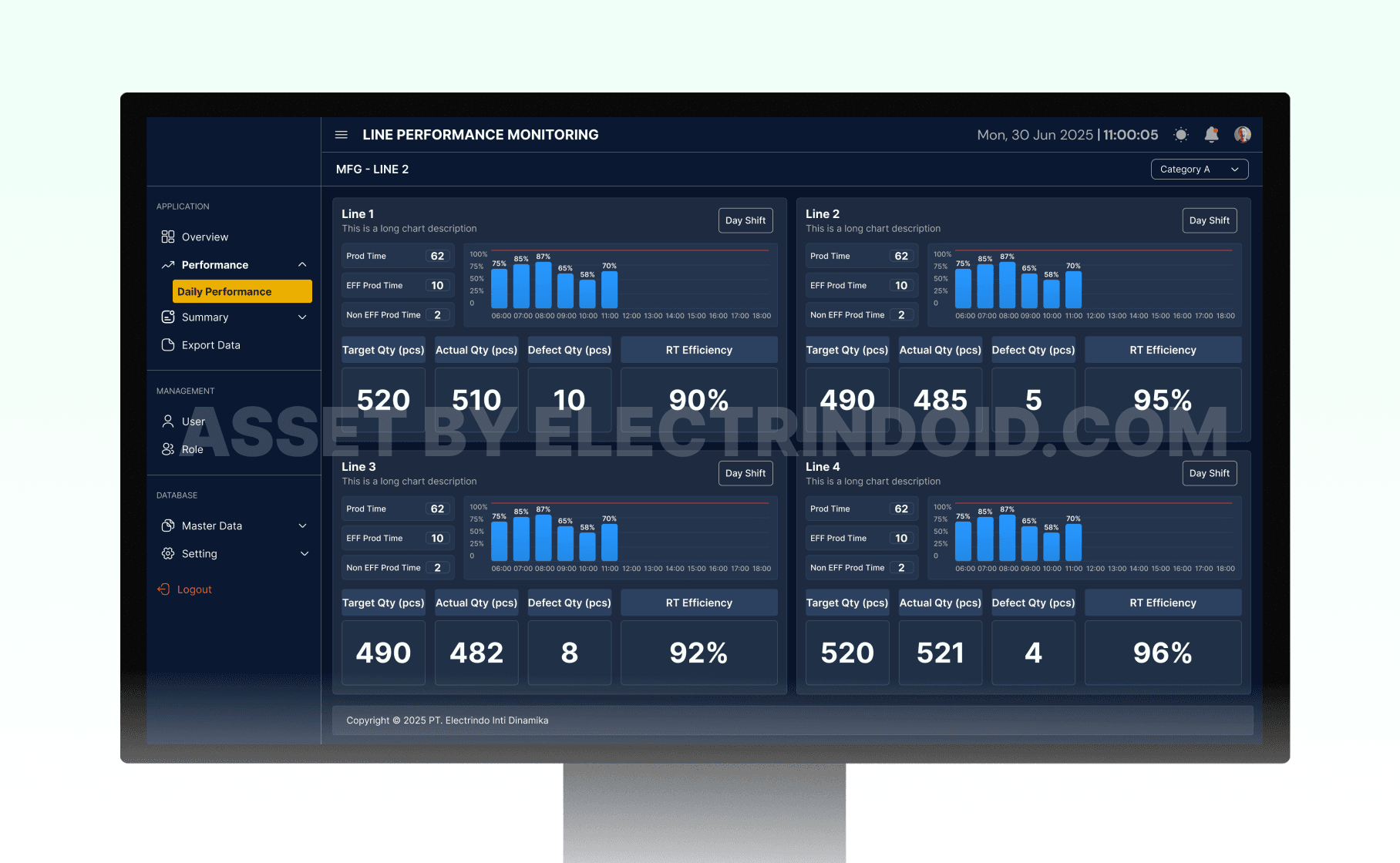
The Production Monitoring System was developed as an integrated platform to monitor production activities and performance in real-time across every production line and shift. The purpose of this system's development is to provide accurate, centralized, and easily accessible production information, allowing the company to monitor process efficiency, identify production downtime (loss time), and gain a comprehensive understanding of operational conditions.
In its development process, this system is designed with a data recording mechanism based on Kanban ID as the primary identifier for each production process. All input and output production data are recorded and traced through the Kanban ID, allowing the system to clearly display the output generated from each kanban. Additionally, this system is equipped with a problem detection feature based on the 4M factors (Man, Machine, Material, and Method) to assist production, engineering, and management teams in conducting analysis and making data-driven decisions.
Challenge
In the manufacturing industry, it is common to find data recording, analysis, and reporting done manually without a system. This leads to several recurring issues.
The effects of manual methods or non-smart production systems are as follows:
- Difficulty tracking the source of production kanban
The company is still facing difficulties in identifying which kanban produces a specific output. This is due to the absence of a system that can directly link the production process with the Kanban ID, making the tracking process manual and requiring more time.
- The recording of production issues is still manual.
Each production line has various categories of issues, such as machinery, materials, or work methods. Currently, the recording and grouping of these issues are still done manually, which slows down the analysis process and may increase production downtime (loss time).
- Monitoring production line performance trends has not been integrated yet
Production data and issues on each line have not been presented in a trend or summary format that is easy to read. As a result, the company struggles to identify recurring problem patterns and to evaluate the overall performance of the production lines.
- The absence of role settings and focus on problem handling
There is currently no system in place to regulate the distribution of roles for each user, such as operator, engineering, and management. This leads to difficulties in focusing on problem handling according to each party's responsibilities, resulting in a less optimal problem-solving process.
Project Goal
This project aims to:
- Providing accurate and real-time production results information, covering both OK and NG products, so that production quality conditions can be monitored transparently.
- Display the production quantity in detail based on Kanban ID, production line, and work shift each day to facilitate tracking and performance evaluation.
- Improving production process efficiency by reducing manual recording, speeding up workflows, and supporting data-driven decision making.
- Enables early detection of issues on each production line so they can be addressed quickly, accurately, and in a coordinated manner through a kanban system, notifications or alarms, and clearly defined roles in each division according to the type of problem that occurs.
Features Offered
The main features implemented in this system include:
1. Production Monitoring & Visualization
- Monitoring production data in real-time on each line.
- Visualization of performance and production efficiency that is easy to understand.
- Menu Overview to monitor the condition of each line in real-time with OK and NG status based on the categories of Safety, Quality, Efficiency (EFF), and Henkaten.
2. Production Management & Loss Time
- Recording and managing production events and loss time, including unplanned losses.
- Menu Summary displaying a summary of production results per part number, defect or loss data, and issue tables for each line.
- Daily reports and shift summaries as materials for evaluating production performance.
3. Trend & Performance Analysis
- Trend Performance Line presenting data on target quantity, actual quantity, defect quantity, and real-time efficiency per line and per shift.
- Trend Data Summary per Line is an accumulation of planned and actual production data for each line on a monthly basis.
4. Role-Based Dashboard
- Dashboard Operator, which allows operators to scan kanban barcodes to view the current model, activity log, production history, targets, and line efficiency.
- Production Summary for Maintenance and Quality, which presents the history of issues on the line and facilitates monitoring based on the roles or divisions involved.
5. System Integration
- API for external integration, allowing the system to connect with other applications or systems used by the company.
Result
Some of the changes and improvements felt after the implementation of this system include:
- Monitoring the production line conditions becomes more effective, as the system can display abnormal conditions in real-time, allowing potential disruptions to be identified immediately.
- Identify the root causes of issues on each line more clearly, by grouping the causes based on the 4M factors (Man, Machine, Material, and Method) that occur in the field.
- Communication and coordination among engineers become more focused, as every issue can be directly addressed by the responsible parties, including the quality team, maintenance, and other related divisions.
- Analyzing problem trends and production performance has become easier, especially within the time frame of each shift, allowing for quicker identification of disruption patterns.
- Production output can be monitored in real-time, both for products in good condition and those that are not good (NG), making quality control more optimal.
- Each role has a distinct and clear monitoring focus, aligned with its respective responsibilities, making problem-solving more effective.
- Achieving production targets per hour and per shift has become more orderly and controlled, as all production data can be monitored transparently every day.